Submit Your Cost Segregation Study
We’ll re-run your cost segregation for free. If our individualized component mapping finds more than $5,000 in additional deductions, you can access the corrected study at a discounted rate to close the gap. We’ll tell you exactly what’s driving it.

How the Unlevered engine works
Source facts become a rebuilt property model. The engine runs deterministic queries across that model, an engineer QA agent checks the result, and exceptions route to human review. This is what a flat allocation, or a chat model guessing, can’t do.
Rebuilt property file
Property graph- Category
- Modeled asset
- Source
- All synced sources
- Class
- Engine-ready facts
- Basis
- Reconciled basis
The rebuilt asset is the input. The tax schedule is the output.
Lost the receipt? The component library rebuilds it.
Every extracted component maps to a proprietary library row: asset category, brand tier, installed-value range, useful life, MACRS class, and the source that backs it. Down to the brand of your stove, because a La Cornue range and a builder-grade electric should never collapse into the same generic bucket.
Builder-grade → Whirlpool → Thermador → Sub-Zero / Wolf → La Cornue
Builder vinyl plank → engineered oak → wide-plank hardwood
Stock laminate → semi-custom quartz → custom stone + built-ins
Contractor pack → recessed systems → designer fixtures
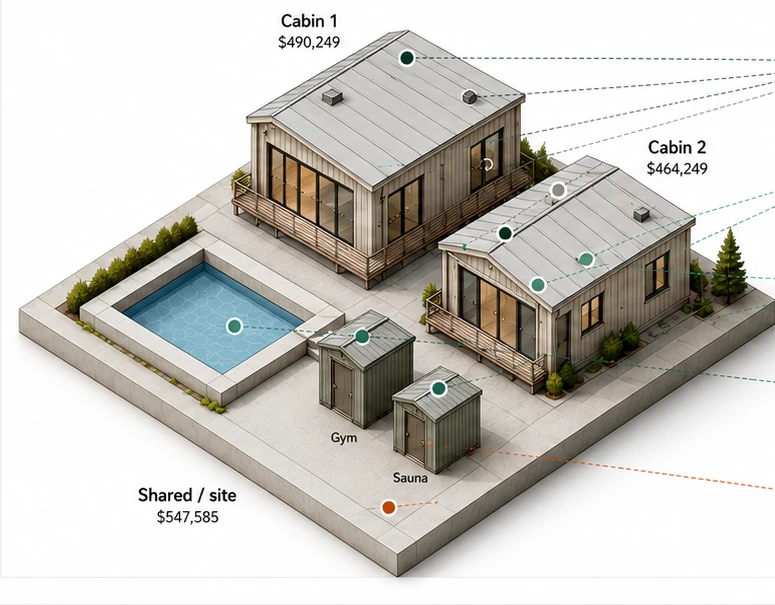
Relocatable prefab gym, sauna, studio: classified by what they physically are
Decks, fencing, paving, pool, landscaping: from permits + aerial evidence
No receipts? No problem. Unlevered’s large-scale component library can identify and price out items added to your home like furniture, lighting, sofas, and more.
What we’ve found
Real properties, rebuilt by the engine. No two asset maps read alike. That’s the point.

A casualty rebuild with a detached ADU: a prefab gym studio and sauna. Because those units are relocatable, they classify as their own five-year personal property instead of disappearing into the building shell with the rest of the structure.

The owner gut-remodeled after placing the home in service, then missed two moves: they never disposed of the original components they tore out, and never accelerated the new investment.
See if your cost seg left value behind. Free either way.
Submit your studyHow the challenge works
- 1Submit once
Your contact details, your existing study, and any supporting files: closing statement, remodel invoices, photos, listing, floor plan. One submission is all we need.
- 2The engine rebuilds the property
A second-look analysis against Unlevered’s asset-map methodology: evidence extraction, component library, basis separation, and the tax logic engine.
- 3A person reviews the output
A trained tax quality FDE on the Unlevered team reviews the output and coordinates any specialist reviews required before release. No automated verdicts. A real person follows up within 30 days.
- 4You get a straight answer
A gap: we tell you what it is and an estimated range for the additional deduction, a range at this stage, not a final number. No gap: we say your study holds up. Free either way.
The offer, plainly
- Engine-run second look at the study you already paid for
- Human QA before any finding is released
- Gap found: an estimated range and exactly where it comes from
- No gap: we say so, and confirm your study appears consistent
- No obligation attached to either answer
Our studies are $5,000 retail. If the reverse-engineering finds a gap worth more than $5,000, you can choose to purchase the corrected study at $1,000 during our 2026 Challenge.
- A full updated study: asset map, the Workpaper, sourced documentation
- Form 3115 / §481(a) catch-up package for your preparer
- No amended returns. The catch-up lands on this year’s return
- Built to be defensible: sourced facts, citations, examiner-response file
The honest trade-off: not every study has a gap, and findings depend on the documentation provided.
Questions owners actually ask
Why is the review free? What's the business model?
Simple: our studies are $5,000 retail. If the reverse-engineering finds a gap worth more than $5,000, you can choose to purchase the corrected study at $1,000 during our 2026 Challenge. Some owners take that; many just want the answer. Either way the review costs you nothing, and we'll tell you what we found in plain terms before you decide anything.
Who actually reads my study?
The engine runs the analysis; a trained tax quality FDE on the Unlevered team reviews the output and coordinates any specialist reviews required before release. No automated result is ever sent. Expect a follow-up from a real person within 30 days.
What happens to my files?
They're used to perform the review, scanned on upload, encrypted, stored on U.S. infrastructure, and never sold or shared beyond what the review requires. You don't need to include Social Security numbers; feel free to redact them. If nothing comes of the review, you can ask us to delete everything.
What if my study is fine?
Then we say so, plainly: based on the submitted files, the existing study appears consistent with its result. That answer is free too. Not every study has a gap; findings depend on the property and the documentation provided.
Will I have to amend prior returns?
No. Where a correction applies, missed depreciation is generally captured through a change in accounting method (Form 3115 and the §481(a) adjustment) on the current-year return, a mechanism written into the code for exactly this. Unlevered prepares the study and the Workpaper; your own tax preparer determines the filing positions and files the return.
I lost my remodel receipts. Is there any point?
Often, yes. Premium flooring, custom cabinetry, high-end appliances, and outdoor improvements leave visible evidence. Unlevered doesn't pretend the receipt exists; it builds a source-labeled, confidence-scored value range from what can be seen and supported, and tells you which is which.
See if your cost seg left value behind.
5 of 100 studies reverse engineered in the 2026 Challenge. Yours could be next.