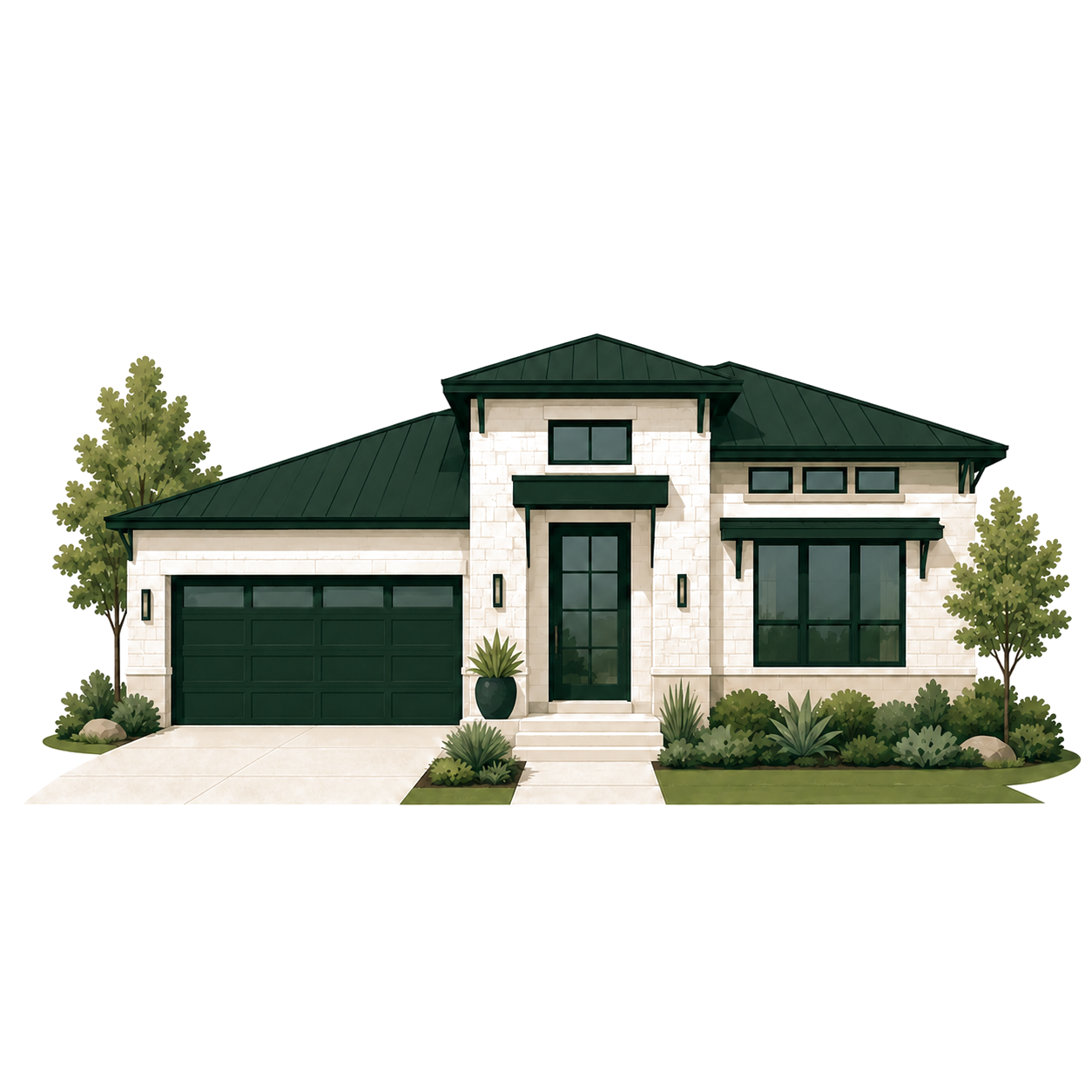
Cost segregation case study · Short-term rental
The Bouldin Creek Studio
2114 Kinney Avenue, Austin, TX 78704 · placed in service Jun 12, 2025
Why this study reads the way it does
A studio under his own roof, and ten days that cost $31,809
The owner is a software engineer, single, on the road for work much of the year. The garden-level studio under his Austin home has its own entrance, kitchenette, and bath: a self-contained dwelling unit, so the engine ran a real cost segregation on the studio’s 28% share of the home with no §280A income cap. The deduction is real. The timing is what planning would have changed.
100% bonus, missed by ten days
Acquired January 9, 2025 · cutoff January 19, 2025
The 2025 tax law restored 100% bonus depreciation for property acquired after January 19, 2025. This home closed January 9, so the engine applies the 40% phase-down rate. Re-run with a post-cutoff acquisition, the same study’s year-one deduction is $65,174 instead of $33,365: $31,809 pushed from year one into the out-years, on ten days’ difference.
The conversion came before the unit existed
Build-out spring 2025 · placed in service June 12, 2025
The studio was converted before it was first listed. Finishes torn out before a property enters service have no in-service basis, so there is no partial-disposition write-off here, and the spend folds into opening basis instead of standing as receipt-traced components. Sequenced the other way (in service first, then remodel), the removed components’ remaining basis becomes a separate year-one deduction.
The lesson. Hosting part of your own home still supports a real engineered study; the unit’s share gets full treatment. But both misses here were date-driven and knowable in advance: an acquisition pushed ten days, or a conversion sequenced after placed-in-service, changes the year-one number. Plan the study before you buy or build, not at filing time.
Where the cash went
$980K in, split into land and building
The property was bought for $980,000. Land never depreciates, so it's carved out first; the building basis becomes the depreciable pool the study then accelerates.
Where the $980K went
Every dollar in, by where it landed. Land never depreciates; the building basis is what the study accelerates.
Land (never depreciates)$294,000 · 30%
Building basis (from purchase)$686,000 · 70%
Building $686,000 × 28% rental use = $192,080 depreciable basis.
Inside the study
What the engine found
The deterministic engine separated the $192,080 depreciable basis into IRS recovery classes, then the engineered review confirmed every component against the source documents.
ULV-2025-3A10
Engineered review passed · 10 components, 2 sources
Depreciable basis$192K
Short-life reclass$63K · 33%
Year-one deduction$33K
Component allocation
$192,080 depreciable basis across MACRS recovery classes.
5-year personal property$48,020 · 25%
15-year land improvements$15,366 · 8%
39-year building shell$128,694 · 67%
Residential rental building $129KCarpet and flooring (non-pe… $8KWindow treatments $8KCabinetry (non-permanent) $8KAppliances $8KDecorative lighting $8KLinens and decor (non-perma… $8KDriveway and walkways $5K
Year one, in dollars
Accelerated depreciation, taken in year one.
| Accelerated depreciation | $33,365 |
| Total year-one deduction | $33,365 |
| Straight-line without a study | ~$4,925/yr |
About 7× more deduction pulled into year one than straight-line.
Depreciation by year
Year-one spike from bonus depreciation, then the building shell.
| Year 1 | $33,365 |
| Year 2 | $13,396 |
| Year 3 | $9,620 |
| Year 4 | $7,329 |
| Year 5 | $7,258 |
| Year 6 | $5,534 |
| Year 7 | $3,844 |
| Year 8 | $3,844 |
| Year 9 | $3,845 |
| Year 10 | $3,844 |
| Year 11 | $3,845 |
| Year 12 | $3,844 |
| Year 13 | $3,845 |
| Year 14 | $3,844 |
| Year 15 | $3,845 |
| Year 16 | $3,572 |
| Year 17 | $3,300 |
| Year 18 | $3,300 |
| Year 19 | $3,300 |
| Year 20 | $3,300 |
| Year 21 | $3,300 |
| Year 22 | $3,300 |
| Year 23 | $3,300 |
| Year 24 | $3,300 |
| Year 25 | $3,300 |
| Year 26 | $3,300 |
| Year 27 | $3,300 |
| Year 28 | $3,300 |
| Year 29 | $3,300 |
| Year 30 | $3,300 |
| Year 31 | $3,300 |
| Year 32 | $3,300 |
| Year 33 | $3,300 |
| Year 34 | $3,300 |
| Year 35 | $3,300 |
| Year 36 | $3,300 |
| Year 37 | $3,300 |
| Year 38 | $3,300 |
| Year 39 | $3,300 |
| Year 40 | $1,512 |
Method. Allocations follow the IRS Cost Segregation Audit Techniques Guide, Rev. Proc. 87-56, and MACRS (Pub. 946), with the 40% bonus rate (placed in service 2025) applied to qualifying 5- and 15-year property. The engine produces the figures deterministically; AI is used only to sort and extract from uploaded documents. Every line cleared the engineered review.
State tax treatment
What each state does with this deduction
Each state this study touches, classified by how it treats the federal year-one deduction.
Texas (TX)No state income tax
No individual income tax; the federal deduction is the whole story for Texas.
Run on Unlevered · engineered review · ULV-2025-3A10