Geospatial Engineering for Cost Seg™
Case study · Short-term rental · Remodel
Timber Ridge at Sea Ranch
Cost seg lets you use part of your property's value to lower your income taxes. Here is how it worked for a 1969 single-family home, bought in 2024, remodeled and furnished for guests.
Where the $1.27M went
Component allocation
Year one, in dollars
| Accelerated depreciation | $366,192 |
| Partial-asset disposition write-off | $268,846 |
| Total year-one deduction | $635,038 |
| Straight-line without a study | $93,213 |
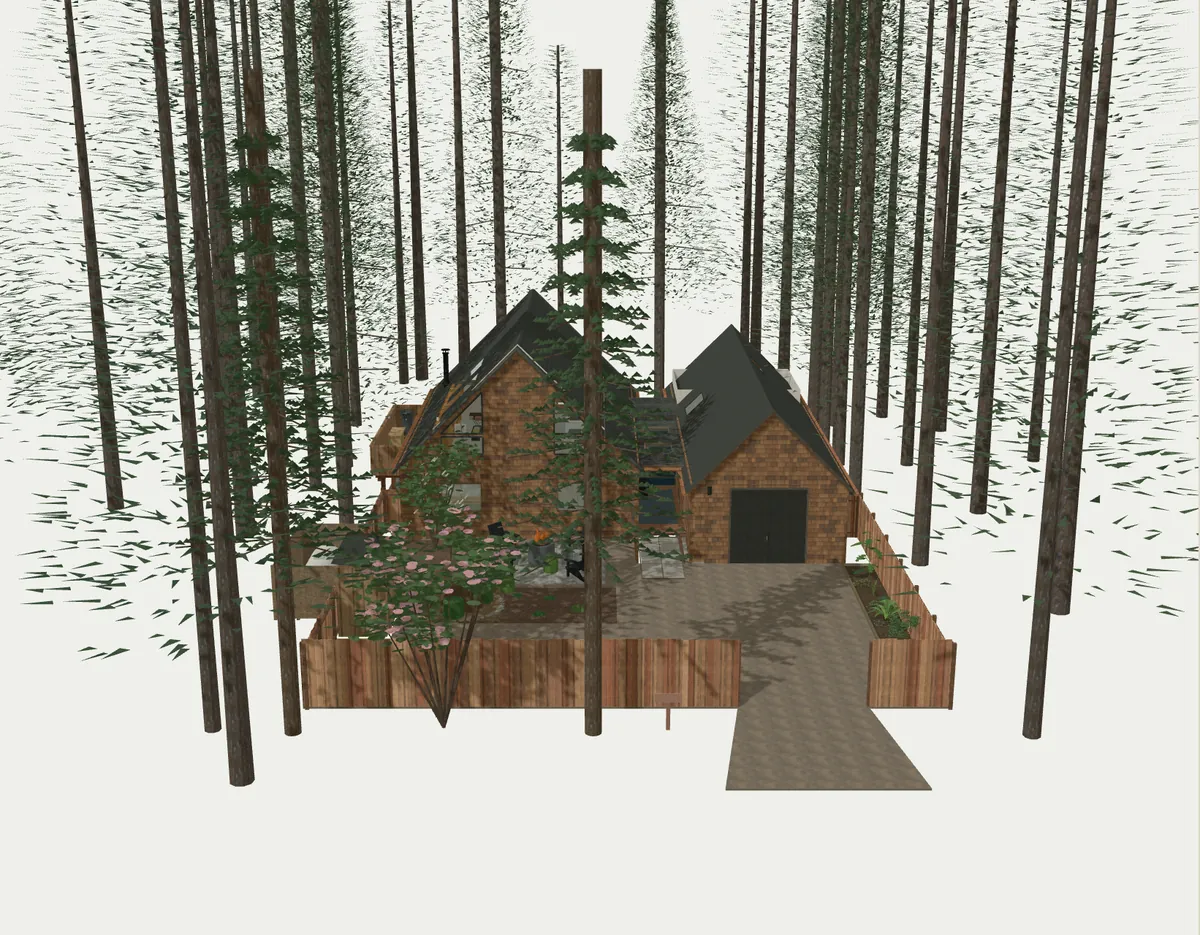 Proprietary 3D Asset Map
Drag to turn · scroll to zoom · tap any part for its tag
Explore the 3D PortalThe study
Six stages, from public record to engineered study.
Pick a stage to see what it did on this house.
Every house fact verified
219Documents on record 191Photos 26Walkthrough videos 112Facts captured 6Sources consulted
- Living area1,578 sq ft2 sources
- Built19693 sources
- Bedrooms and baths2 and 23 sources
- Levels21 source
- Attached garage264 sq ft4 sources
- Lot21,228 sqft2 sources
- Land5.9% of the price1 source
- BoughtMay 10, 20244 sources
- Placed in serviceMay 16, 20241 source
- RemodelYes3 sources
- Rental useShort-term rental2 sources


The Study Algorithm, running
The Study Algorithm
How we find the highest defensible deduction
Every house is different, so we run all 384 combinations of its 7 levers and keep the biggest deduction the record can prove.
The highest defensible deduction on the record is $635,038. Squares that need a fact or are ruled out are shown, never chosen.
Show the decisions
| Decision | Considered | Kept | Why |
|---|---|---|---|
| Land share | Land 40%, the county assessor's land and improvement values | Land 5.8866%, the platform's recorded ruling | The run's own land figure. Comparable vacant-lot sales: No comparable vacant-lot sales are on the study yet; they come from the property research's sale reads (fetch-comps) |
| Qualified improvement property | Leave them in the 39-yr building | QIP on 87 interior improvement lines | Interior, non-structural work placed in service after the building, as ruled |
| Interior Wood Paneling (1 line) | QIP 15-yr | Hold in the 39-yr building | The run's own class until the record settles the line |
| Interior Wood Paneling, Skylights (2 lines) | Deduct now: Repair (Treas. Reg. §1.162-4) | Capitalize and depreciate | The run's own treatment until the record settles the work |
| Partial disposition | Leave them in the building | Write off the removed parts | The election the run made on the removed components |
| Allocation of the residual | Spread over every priced reference lineSpread over every lineClass pipe: the residual by each class's whole cost | Honor every line at cost; name the residual | Each line locks at its own cost and the remainder stays a named 39-yr residual |
| Bonus elect-out | Elect out of bonus on 5-yrElect out of bonus on 15-yrElect out of bonus on 5-yr, 15-yr | Take bonus on every class | Bonus applies by default to property placed in service in the filing year |
| Use of the property | Residential rental | Commercial, nonresidential | The home is operated as transient lodging, so the building is nonresidential real property and recovers over 39 years (IRC §168(e)(2)(A)(ii)(I)). |
| Aging of building lines | No other option replayed | Waits on a record | The 146 building lines are frozen with no age factor carried as a number: the sheet carries a one-valuation ruling, or was loaded before 2026-10-18 with only the aged cost, and reloading it freezes each aged line's factor and cost new. Missing input: age_factor and cost new per aged building line. |
| Regional pricing ladder | No other option replayed | Waits on a record | 229 lines are not priced from a receipt, and each is frozen with only the rung the resolver chose, so the next supportable rung cannot be replayed without inventing a price. Missing input: every rung the resolver found per line (rates.csv rung, the sheet's alt_rate_ids). |
| Section 179 on furnishings | No other option replayed | Not relevant to this property | No furnishings are in the engine basis on this run; Inventory is off or priced outside the engine. |
| Sales tax | No other option replayed | Not relevant to this property | No short-life line states material dollars whose price source excludes sales tax. |
| Shipping | No other option replayed | Not relevant to this property | No line cites a delivery charge, and shipping enters only where one is cited (2026-10-03). |
| Section 179 on building lines | No other option replayed | Fixed by the record | $275,284.25 on 182 lines placed in service in 2024 is section 179-eligible under the 2024 dollar limit and phase-out, reported beside the headline for the preparer to elect on Form 4562; the first-year figure is bonus plus depreciation (2026-10-13). |
| Itemization method | No other option replayed | Crossed as a comparison | Itemized $561,409.24 year one at 36.41% short-life and site, against the cited band's $361,304.53 at 9.95%; itemizing is $200,104.71 higher. |
| Class band | No other option replayed | Crossed as a comparison | For comparison (Eric Lynch, "Cost of Constructing a Home-2024", NAHB Economics & Housing Policy, 2025-01-20, Table 1). The residual is at or over 15% of basis, so the band is selectable as the last defense (rung 8). |
| Retail cost preservation | No other option replayed | Fixed by the record | Receipts, retail items and the owner's paid rows keep their price in every allocation method the replay runs (2026-10-02), so there is no other option to cross. |
| Land improvements | No other option replayed | Fixed by the record | Site work takes its 15-year class from the line itself (Rev. Proc. 87-56, asset class 00.3); the class is read, never chosen. |
| Condo common-element share | No other option replayed | Not relevant to this property | The property is not a condo (str), so it holds no share of common elements. |
| Soft costs and fees | No other option replayed | Not relevant to this property | No fee or soft-cost line is itemized on this run, so there is no fee to allocate. |
| Fruit-bearing plants | No other option replayed | Not relevant to this property | No fruit-bearing planting is on the record, so there is no 10-year class to read. |
| Cost basis composition | No other option replayed | Fixed by the record | The basis is composed from the record's documents before land comes off; each figure is read, never chosen. |
| Measurement accuracy | No other option replayed | Fixed by the record | Quantities are settled and locked before the run (rung 0); a new measurement is a new run, not a replay. |
| Movability answers | No other option replayed | Fixed by the record | The owner's answer governs a movability class (client attestation wins); the alternative contradicts a recorded fact. |
| Shell class, use scope, posture | No other option replayed | Fixed by the record | Frame facts are read from the record, never chosen. |
| Inventory | No other option replayed | Not relevant to this property | Inventory is priced outside the engine basis and reported beside the study; no engine input elects it. |
Defensibility, step by step
Only supportable methods count.
Inventory: the furnishings
Furnishings identified from the photos and priced one by one, deducted apart from the building.


Your portal
Answer a few questions. We do the rest.
How the property is used, what you changed, what you furnished. We fetch the public record ourselves.
One fee, shown up front in the portal.
Turn the house, tap any part, follow the Spatial Graph and read the review.
Questions
Common questions about this study
- What does a real cost segregation study look like?
- This is a complete, engineering-reviewed cost segregation study on a short-term rental property. Every figure is computed by a deterministic engine from source documents, cited to the underlying tax authority, and reproducible, including a 18-room component reclassification and a full depreciation schedule. Addresses and client identities are changed for privacy; the facts and dollars are true engine output.
- How much does this study accelerate into the first year?
- The first-year deduction heads this page, and The Study Algorithm section builds it step by step from the run: the building's shell, each short-life class at 60% bonus depreciation, any remodel disposition and the Inventory.
- Is a cost segregation study like this defensible?
- It is built to the standards in the IRS Cost Segregation Audit Techniques Guide: each component is classified with a citation, the basis derivation is engineered rather than estimated, and every calculation is reproducible. Unlevered prepares and signs the engineering study; the property owner's CPA remains the sole tax return preparer.
- What makes these studies transparent?
- Every number traces to a source. The study shows the room-by-room allocation, the reasoning behind each component's classification, and a calculation that can be reproduced from the same inputs, not a black-box estimate.