Geospatial engineering / Evidence-based cost segregation
Evidence-based cost segregation
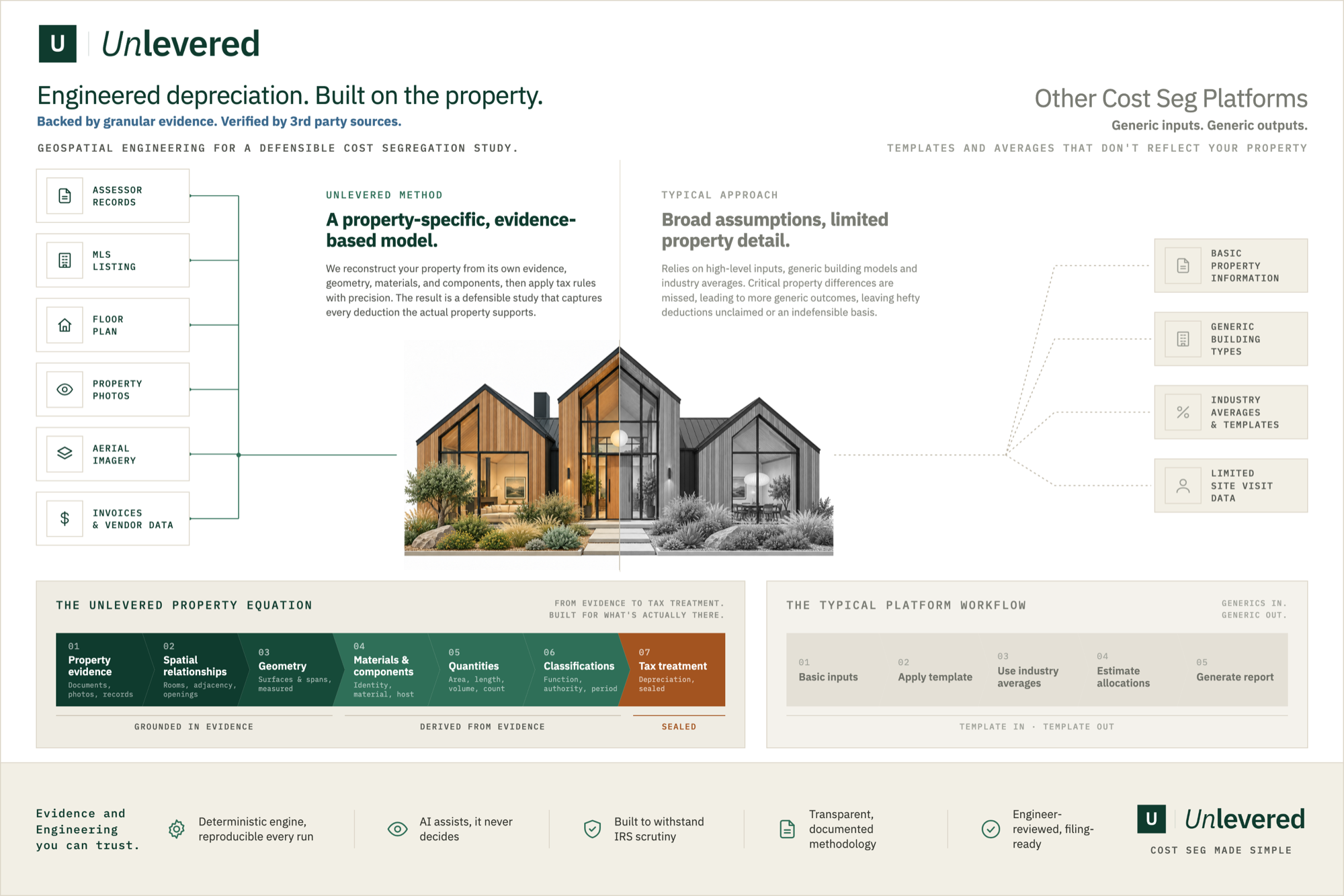
Evidence-based cost segregation means nothing appears in the result that cannot be traced back to why it is there. Unlevered's calculation is deterministic — the same inputs always produce the same study — and every material dollar walks back through a sealed engine run, a component decision, a resolved quantity, a sourced fact, and the original evidence. The delivered study ships with a line-by-line workpaper an examiner can reconcile document by document.
Every dollar traces to a document
Traceability is the spine. Any figure on the schedule can be walked back, step by step, to the evidence that established it.
- 01A dollar on the schedule
- 02The sealed engine run that produced it
- 03The component decision behind the line
- 04The resolved quantity and its equation
- 05The sourced fact the quantity used
- 06The original document that established it
What makes it rigorous
Four properties do the work, and each one is something an examiner or a CPA can check.
Deterministic and reproducible
The engine is pure: no clock, no network, no model call. It produces byte-identical output from the same inputs, enforced in CI by hash replay. The same study calculated twice is the same study, which is what lets it be reproduced years later exactly as delivered.
Sealed and versioned
Every run is stamped with its engine version and a content hash, and a delivered study is sealed under one composite hash with its report, schedules, and workpaper. A delivered study is never rebuilt silently from live data — a correction is a new, linked release.
Engineering reviewed
The physical and engineering case for each material component is reviewed before delivery, and the audit case is challenged the way an examiner would. Conclusions cite governing authority — the Code and regulations, the Whiteco and HCA analyses, and Rev. Proc. 87-56 — recorded against the component, not asserted in a footnote.
Software decides, AI only reads
AI reads unstructured evidence and proposes; deterministic software calculates; a human decides. AI never sets a number, never runs the engine, and is never on the happy path of the calculation. The result does not rest on a model's judgment.
Related: how the property equation is solved and the full methodology.
Common questions
- What is evidence-based cost segregation?
- Evidence-based cost segregation means nothing appears in the result that cannot be traced back to why it is there. Unlevered's calculation is deterministic — the same inputs always produce the same study — and every material dollar walks back through a sealed engine run, a component decision, a resolved quantity, a sourced fact, and the original evidence. The delivered study ships with a line-by-line workpaper an examiner can reconcile document by document.
- Why does reproducibility matter for a cost segregation study?
- If a study cannot be reproduced, it cannot be defended. Unlevered's engine is deterministic and enforced by hash replay, so the same inputs always produce the same numbers. Years after delivery, the study can be reproduced byte for byte with its original version, which is the foundation of an audit defense — the examiner sees the same result the taxpayer relied on, not a number that drifted.
- What is the Workpaper?
- The Workpaper is the complete audit-defense record for a sealed study: a line-by-line trace from every figure on the schedule back through the engine run, the component decision, the resolved quantity, and the sourced fact to the original evidence. It is bound to the same sealed run as the report, so the report and the workpaper can never disagree.
- How do you decide a component's tax treatment?
- By resolving the actual component in the actual property — its function, how it is installed and removed, and the governing authority — rather than defaulting to a safe-looking bucket. Where treatment depends on permanency, the Whiteco six-factor analysis is recorded against the component with its evidence; classification and recovery periods follow the Code, the regulations, and Rev. Proc. 87-56. The reasoning is written down, not asserted.
- Is this more defensible than a template-based study?
- It is built to be. A template applies industry averages and cannot show why a particular number is correct for a particular property. An evidence-based study can: it reproduces exactly, traces every dollar to a document, and records the engineering and legal reasoning behind each material classification. That trail is what an examiner asks for.
A study you can defend, line by line.
Start with one address, or read a real engineered study and follow a number back to its evidence.